
MDA 2026: Dyne advances DMD therapy z-rostudirsen toward approval
Trial data show increased dystrophin, trends in functional improvement
Written by |

Dyne Therapeutics is advancing its investigational exon-skipping therapy zeleciment rostudirsen (z-rostudirsen), formerly known as DYNE-251, toward regulatory approval after trial data showed early signs of benefit across multiple disease measures in boys with Duchenne muscular dystrophy (DMD).
The most recent data from the Phase 1/2 DELIVER clinical trial (NCT05524883) showed that the therapy increased levels of dystrophin — the protein that’s lacking in people with DMD — and showed trends of improvement across several functional measures. It also suggested potential stabilization of heart and lung function.
The findings were presented at the 2026 Muscular Dystrophy Association (MDA) Clinical & Scientific Conference, held March 8-11 in Orlando, Florida.

Researchers, company discuss implications of DELIVER findings
At the annual meeting, Muscular Dystrophy News Today spoke with the study’s principal investigator, Kevin Flanigan, MD, and Dyne’s chief medical officer, Douglas Kerr, MD, PhD, about what the data mean for the DMD community and the future of z-rostudirsen’s development.
Flanigan, of the Nationwide Children’s Hospital in Columbus, Ohio, said that if z-rostudirsen is approved, it could become, “a significant tool in the toolbox for [DMD] treatment.”
Dyne is now planning to seek accelerated U.S. approval of z-rostudirsen for people with DMD amenable to exon 51 skipping, based largely on the observed increase in dystrophin levels. The company expects to submit its application in the next few months, with a potential launch at the beginning of 2027 if approved.
Accelerated approval would allow Dyne to conditionally market z-rostudirsen based on early evidence that it is likely to benefit patients. Full approval would require additional data confirming clinical benefit.
To that end, the company has also aligned with U.S. regulators on the design of a Phase 3 clinical trial that could provide such data. The trial is expected to launch in the coming months.
“We expect that this would confirm the findings from DELIVER and allow for full approval in the U.S. and then in other geographies throughout the world, because we want to really make this available to every boy with DMD,” Kerr said.
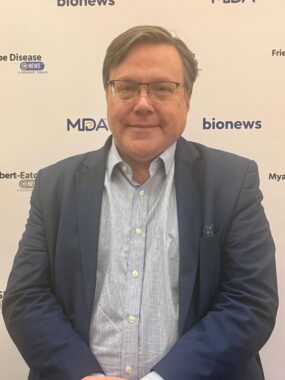
Kevin Flanigan, MD, is the principal investigator for the DELIVER clinical trial. (Photo by Kellie Benn)
In DMD, symptoms such as muscle weakness and wasting result from a lack of the muscle-protecting protein dystrophin. That deficiency is caused by mutations in the DMD gene.
Certain DMD-causing mutations cause the protein-coding segments of DMD, called exons, to misalign. As a result, the body’s protein-making machinery can’t properly read the genetic instructions, leading to a “truncated or nonfunctional dystrophin protein,” Kerr explained.
As an exon-skipping therapy, z-rostudirsen is designed to skip a specific exon, in this case exon 51, to allow the remaining ones to properly align. This enables production of a shortened, but “near full-length and highly functional” dystrophin protein, Kerr said.
Flanigan added that the version of dystrophin made after exon-51 skipping is expected to be “highly protective,” based on data from people with the milder Becker muscular dystrophy (BMD), who have naturally occurring DMD mutations that result in a dystrophin protein similar to that produced with exon 51 skipping.
Targeted delivery aims to boost dystrophin levels
There’s one other exon 51-skipping therapy currently approved in the U.S. — Exondys 51 (eteplirsen). Z-rostudirsen is designed to potentially achieve higher levels of high-quality dystrophin. The drug is linked to an antibody fragment that helps guide it to its target tissues, resulting in “really very high levels of uptake into … skeletal muscle and heart tissues,” according to Flanigan.
Both z-rostudirsen and Exondys 51 are given by infusion into the bloodstream. However, Exondys 51 requires weekly infusions, while z-rostudirsen is being tested as a roughly once-monthly treatment.
Flanigan noted that patients may have difficulty tolerating weekly treatment. Frequent infusions can also create practical challenges, such as taking time off from school or work. Switching to a monthly therapy, he said, “would make a significant impact … for patients and their families.”

Douglas Kerr, MD, PhD, is the chief medical officer for Dyne Therapeutics. (Photo by Kellie Benn)
DELIVER trial tests dosing, early outcomes
DELIVER was designed to test DYNE-251 against a placebo in boys with DMD, ages 4 to 16. In the first part, various doses were evaluated, with a regimen of 20 mg/kg given every four weeks selected for further study in the registrational expansion cohort. That part enrolled 32 participants, who received either z-rostudirsen or a placebo for about six months.
In a presentation titled, “Zeleciment Rostudirsen Significantly Increased Dystrophin Protein Levels and Led to Functional Improvement in Clinical Measures in the DELIVER Trial,” Flanigan discussed the data from participants who received z-rostudirsen in the registrational expansion cohort.
The results showed that dystrophin levels significantly increased to nearly 5.5% of normal — after adjusting for muscle content — in people treated with z-rostudirsen, representing about a sevenfold increase from the study’s start.
Data from four participants who underwent muscle biopsies showed that muscle content-adjusted dystrophin levels increased to more than 18% of normal after at least a year.
Although the analysis included only a small number of patients, the finding is “consistent with the idea that longer treatment will continue to accrue benefit over time,” Flanigan said, noting that this is “different than some therapies that are currently out there.”
“This preliminary data excites me very much as a neurologist,” he added.
Functional measures show early trends across multiple domains
People given z-rostudirsen tended to show improvements compared with placebo across six functional tests, spanning lower-limb strength and stamina, upper-limb function, and lung function.
“One of the things that we tried to do in the DELIVER study is to look at a series of endpoints that capture disability across different domains in [DMD],” Kerr said, noting that improvements across all these domains were “very satisfying to see.”
Flanigan said the results of the Time to Rise test were among the most striking findings. The test measures how quickly a child with DMD can stand up from a lying-down position. The difference between z-rostudirsen and placebo in this test was reported to be both statistically significant and clinically meaningful.
“One of the real complaints we see in patients, if you think just being able to get up off the floor, get up off a chair, those are meaningful things in the everyday life for patients,” Flanigan said. “To see that improvement is expected to be translated into really meaningful day-to-day function for boys.”
Compared with an external group of untreated boys with DMD, participants given z-rostudirsen in DELIVER also showed improvements after six months across several functional tests.
Kerr also noted that in a group of boys who had received a lower dose of z-rostudirsen in the first part of DELIVER and were later switched to the 20 mg/kg regimen, functional gains appeared to be preserved for up to two years.
“So it wasn’t just a short-term benefit,” Kerr said. “It seemed to persist over a long period of time. And we were very gratified by that.”
Early data suggest potential heart and lung benefits
Beyond motor function, z-rostudirsen has shown potential heart and lung benefits in DELIVER. Those data were presented in a poster titled, “Zeleciment rostudirsen led to trends in long-term improvement in clinical outcomes including cardiopulmonary function: Additional data from DELIVER.”
The analysis included participants who had always been on the 20 mg/kg monthly dose, as well as others who had switched to it from another dose in an open-label extension period.
Data showed a trend toward improvement in lung function after two years compared with published natural history data from untreated DMD patients. Measures of heart function likewise suggested a possible preservation of function relative to the expected declines in the natural course of the disease.
Flanigan noted that although the data are limited by the relatively small number of participants, the findings are “really quite meaningful,” particularly given that heart and lung problems are a leading cause of serious complications and death for boys with DMD after they’ve lost the ability to walk.
We expect that this would confirm the findings from DELIVER and allow for full approval in the U.S. and then in other geographies throughout the world, because we want to really make this available to every boy with DMD.
That the therapy reaches the heart, Flanigan said, means “we can expect really long-term benefit for patients, ambulatory and nonambulatory.”
Z-rostudirsen has also demonstrated a generally favorable safety profile in the study, and Flanigan said that if approved, the therapy could potentially be used from childhood — as early as a potential prescribing label would allow — through adulthood.
Phase 3 trial planned to confirm findings from DELIVER
The planned Phase 3 trial of z-rostudirsen will be a larger and longer study designed to “confirm and extend the benefits” seen in DELIVER, according to Kerr. It will assess the effects of z-rostudirsen on muscle function and strength, as well as neurological, cardiac, and pulmonary function.
Meanwhile, Dyne is also developing therapies for DMD amenable to skipping of other exons, including 53, 45, 44, and 55. These programs are still in preclinical development and are designed similarly to z-rostudirsen.
“I don’t know when those are going to get into the clinic, but we’re very interested in them,” Kerr said. “We think it’s a great opportunity to … be able to access a broader portion of DMD who are amenable to exon skipping.”
Note: The Muscular Dystrophy News Today team is providing live coverage of the 2026 MDA Clinical & Scientific Conference March 8-11 in Orlando, Florida. Go here to see the latest stories from the conference.