

Skip to content
Muscular Dystrophy News logo
Newsletter
  • About MD
    Muscular dystrophy overview
    • Causes
    • Symptoms
    • Diagnosis
    • Life expectancy
    Treatments
    • Approved treatments
    • Experimental treatments
    • Non-drug treatments
    Types
    • Becker muscular dystrophy
    • Bethlem myopathy
    • Congenital muscular dystrophies
    • Duchenne muscular dystrophy
    • Facioscapulohumeral muscular dystrophy
    • Limb-girdle muscular dystrophy
    • Myotonic dystrophy
    • Tibial muscular dystrophy
  • Living with
    Living with muscular dystrophy
    Exercise and physiotherapy
    Diet
    Breathing difficulties
    Heart problems
    Joint care
    Support and resources
    Assistive technology
    Speech therapy
  • Community
    Perspectives
    • Duchenne: Shalom’s Lifelong Partner-in-Crime — Shalom Lim Ern Rong
    • Muscle Memoirs: LGMD Experiences — Patrick Moeschen
    • Party of 9 — Betty Vertin
    • Working Through the Process — Robin Stemple
    More Perspectives
    • Bloom – Prudence Jones
    • Hawk’s-Eye View – Hawken Miller
    • Hidden Truths – Adeel Rizvi
    • Of Dragons and Dystrophin – Andy Rusch
    Guest Voices
  • News
  • Forums
  • Resources
    Video & Podcasts
    • Treatment risks and uncertainty
    • Setting boundaries with caregivers
    • Overcoming discomfort
    • Finding motivation
    • Mental health support
    Featured Topics
    • Caregiver’s guide to DMD
    • Adaptive living
    • Navigating DMD
    Advocacy partners
    Clinical & Scientific Conference Coverage

AMO-02 for myotonic dystrophy type 1

Last updated Oct. 13, 2025, by Marisa Wexler, MS
✅ Fact-checked by José Lopes, PhD

Administration
Clinical trials
Side effects


What is AMO-02 for myotonic dystrophy?

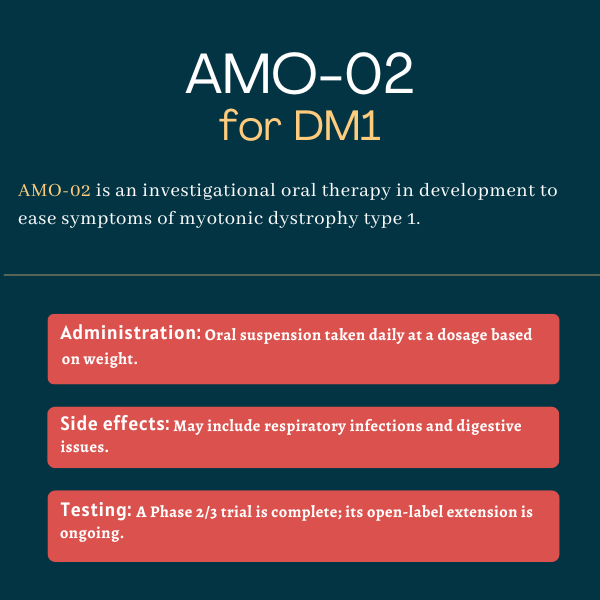
AMO-02 (tideglusib), an experimental oral treatment from AMO Pharma, is being developed to slow disease progression in myotonic dystrophy type 1 (DM1).

DM1 is a genetic disorder marked by muscle weakness, wasting, and myotonia (an inability for muscles to relax after contracting). AMO-02 is designed to inhibit the activity of a muscle enzyme called glycogen synthase kinase 3 beta, which normally helps regulate energy storage in muscle cells but is overactive in DM1 patients.

Preclinical studies in a mouse model of DM1 suggested that blocking this enzyme may reduce muscle weakness and myotonia. AMO-02 also targets the disease-causing accumulation of certain abnormally long RNA molecules that clump inside cells and impair their normal functioning.

AMO-02 is also in clinical development as a potential treatment for arrhythmogenic right ventricular cardiomyopathy, a form of heart disease.

Therapy snapshot

Treatment name: AMO-02
Administration: Oral suspension
Clinical testing: Open-label extension of Phase 2/3 trial ongoing


How will AMO-02 be administered?

AMO-02 is available as an oral suspension. In a Phase 2/3 clinical trial in congenital DM1, the therapy was administered daily at weight-adjusted doses ranging from 400 to 1,000 mg per day.
AMO-02 in clinical trials

A Phase 2/3 clinical trial called REACH-CDM (NCT03692312) tested AMO-02 against a placebo in 56 children and adolescents with congenital DM1 ages 6 to 16.

  • REACH-CDM aimed to show that patients given AMO-02 would have significantly better scores on the Clinician-Completed Congenital DM1 Rating Scale (CDM1-RS), a clinician-rated measure of DM1 disease severity. The study failed to meet this goal; no difference in CDM1-RS scores was seen between AMO-02 and the placebo after 20 weeks. Still, the findings showed a clinically and statistically significant improvement in a measure of cognition, a significant decrease in levels of a biomarker of muscle damage, and a trend toward improvement in a tool of walking ability.
  • An extension study called REACH CDM-X (NCT05004129) is ongoing in patients who completed the parent study, as well as previously untreated congenital or childhood-onset DM1 patients, up to age 45. All participants are being treated with AMO-02 and monitored for long-term outcomes. Recent data at about four years of follow-up showed that the average hospitalization rate per patient was lower than once every six years. Additionally, participants aged 10 years and older showed little or no decline in walking function over one year of treatment. AMO-02 therapy was generally well tolerated.

AMO has announced plans for a Phase 3 trial to evaluate the safety and efficacy of AMO-02 in adult-onset DM1. The trial is expected to have a similar design to REACH-CDM.

AMO-02 side effects

The most common adverse events seen in patients on long-term AMO-02 treatment during the REACH CDM-X trial were respiratory infections and digestive events.


Muscular Dystrophy News Today is strictly a news and information website about the disease. It does not provide medical advice, diagnosis, or treatment. This content is not intended to be a substitute for professional medical advice, diagnosis, or treatment. Always seek the advice of your physician or other qualified health provider with any questions you may have regarding a medical condition. Never disregard professional medical advice or delay in seeking it because of something you have read on this website.

Recent Posts

  • Early trial data support RNA therapies for two muscular dystrophy types
  • MDA 2026: Dyne therapy boosts strength, cognition in DM1
  • MDA 2026: Early trial of PGN-EDODM1 shows biomarker activity in DM1
  • New ‘pothole-filling’ RNA strategy targets the genetic root of DM1
  • Myotonic dystrophy drug SRP-1003 trial advances to higher doses


Related articles

  1. The words Discussion
    News

    European regulators back new DMD gene therapy with key status

  2. banner for Betty Vertin's Discussion
    Columns

    I am watching a child lose his independence for the third time

  3. An illustration of a family holding hands crossing as stream. Discussion
    News

    CureDuchenne’s annual conference to highlight research, family support

  4. Banner for Robin Stemple's column, Discussion
    Columns

    With my mobility severely limited, I’m in dire need of a wheelchair

  5. A clinician and another person stand side by side, flashing a thumbs-up sign. Discussion
    News

    EU panel recommends expanded use of DMD treatment Agamree

  6. A child uses a cardboard box as a boat and peers through a spyglass while pretending to be a sailor. Discussion
    News

    Starting corticosteroids earlier helps improve motor function in DMD

  Subscribe to our newsletter

Get regular updates to your inbox.

This field is for validation purposes and should be left unchanged.

Bionews Logo Bionews, Inc.

3 W Garden St
Suite 700
Pensacola, FL 32502
Website: bionews.com
Email: [email protected]
Phone: 1-800-936-1363

  • Muscular Dystrophy News on Facebook
  • Muscular Dystrophy News on X
  • Muscular Dystrophy News on Instagram
  • Muscular Dystrophy News on Pinterest
  • About Us
    • Our Culture
    • Leadership
    • Careers
    • Contact Us
  • Explore More
    • Advertising Policy
    • Corrections Policy
    • Editorial Policy
    • Privacy Policy
    • Terms of Service
Disclaimer

This site is strictly a news and information website about the disease. It does not provide medical advice, diagnosis or treatment. This content is not intended to be a substitute for professional medical advice, diagnosis, or treatment. Always seek the advice of your physician or other qualified health provider with any questions you may have regarding a medical condition. Never disregard professional medical advice or delay in seeking it because of something you have read on this website.

Copyright © 2013-2026 All rights reserved.

Log in

Don't have an account?

Log in

[wppb-login register_url="/register" lostpassword_url="/recover-password" ajax=true]

|

Register

Already have an account?

Register

Create your account by filling in the information below:

[wppb-register redirect_url="/welcome" ajax=true]

By creating an account, you are agreeing to the Privacy Policy and Terms of Service.

Reset Password

[wppb-recover-password ajax=true]