
Sevasemten for Becker and Duchenne muscular dystrophies
 Fact-checked by Inês Martins, PhD
What is sevasemten for Becker MD and Duchenne MD?
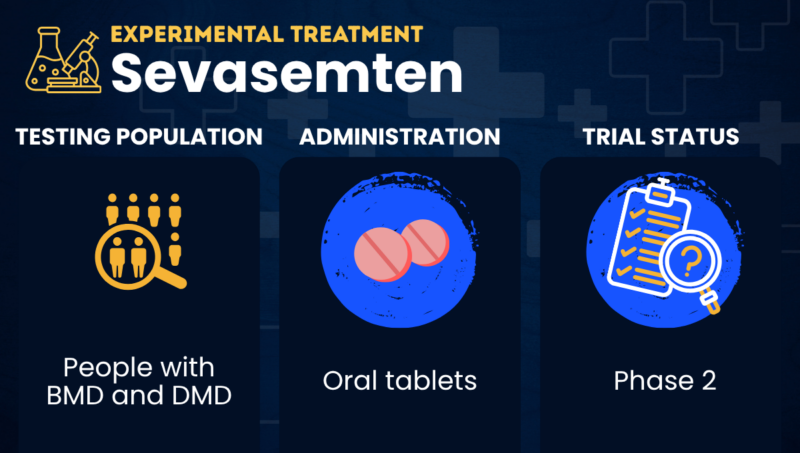
Sevasemten (EDG-5506) is an experimental oral therapy being developed for Duchenne muscular dystrophy (DMD) and Becker muscular dystrophy (BMD). It is designed to protect muscles from damage and is being studied as a once-daily tablet.
DMD and BMD are types of muscular dystrophy caused by mutations in the DMD gene, which provides instructions for producing dystrophin, a protein that acts like a shock absorber during movement to protect muscle cells.
When dystrophin is absent or abnormal, muscle fibers are more vulnerable to injury during normal contractions. Repeated damage gradually causes muscle tissue to be replaced by fat and scar tissue, contributing to progressive muscle weakness.
Sevasemten is a fast myosin inhibitor designed to reduce the force generated by fast-twitch muscle fibers, which generate fast and powerful contractions that are needed for activities like running, jumping, and climbing stairs. By making these contractions less forceful, sevasemten is intended to protect dystrophic (weakened) muscle from repeated damage that arises from muscle contractions.
Sevasemten was initially being developed by Edgewise Therapeutics, but the program was acquired by Servier in 2026.
Therapy snapshot
Scroll horizontally to view all columns -->
| Treatment name: | Sevasemten |
| Administration: | Oral tablets |
| Clinical testing: | In Phase 2 clinical testing for DMD and BMD |
How will sevasemten be administered?
Sevasemten is being developed as an oral tablet to be taken once daily at night.
Different doses have been evaluated in clinical trials. A daily dose of 10 mg was selected for further clinical testing in adults with BMD and as the target dose for future Phase 3 testing in DMD. However, because sevasemten remains an experimental therapy, there is no approved dosage or administration schedule.
Sevasemten in clinical trials
Sevasemten was first tested in two Phase 1 clinical trials (NCT04585464 and NCT05160415), which showed the therapy was safe and well tolerated in adults with BMD, and was also associated with stable physical function and reductions in muscle damage biomarkers over two years. The data supported the initiation of Phase 2 clinical trials in both BMD and DMD.
BMD clinical trials included:
- A now-complete Phase 2 clinical trial, called CANYON, which tested sevasemten in 40 men and 29 adolescents boys with BMD. Participants were randomly assigned to receive sevasemten once daily (10 mg in adults, 5 mg or 12.5 mg in adolescents), or a placebo, for one year. CANYON met its main goal, with sevasemten reducing creatine kinase, a biomarker of muscle damage, by 28% compared with the placebo. The therapy also appeared to slow motor function declines, but these findings were not significant.
- CANYON later expanded into a pivotal trial called GRAND CANYON (NCT05291091), which is testing the 10 mg dose of sevasemten in an additional 175 men with BMD. In addition to measuring creatine kinase, another main goal is to test if sevasemten can prevent a decline in motor function over 18 months. Results from this trial may support regulatory applications seeking the therapy’s approval for BMD.
- Participants who complete the previous BMD trials are eligible to enter an ongoing open-label extension study, called MESA (NCT06066580), and receive sevasemten for up to an additional three years. Early data from participants who received the therapy for at least one year in their main trial and MESA showed that sevasemten continued to keep the motor function stable over up to 3.5 years.
Additional studies are evaluating sevasemten in children and adolescents with DMD:
- The Phase 2 LYNX clinical trial (NCT05540860) enrolled 76 boys with DMD, ages 4 to 9, who received different doses of sevasemten or a placebo for about three months before entering an open-label extension study, in which all are receiving sevasemten for up to four years. Early findings showed encouraging trends across measures of motor function, and supported selection of a 10 mg daily dose for further development in DMD.
- The Phase 2 FOX trial (NCT06100887) is evaluating sevasemten in 43 children and adolescents with DMD, ages 6 to 14, who previously received a gene therapy. As in LYNX, participants were assigned to receive different dosages of sevasemten or a placebo for about three months, after which they entered an open-label extension lasting about three years. Initial findings suggested that the 10 mg dose may reduce the rate of functional decline, but complete results have not yet been published.
Potential side effects of sevasemten
Sevasemten’s safety profile is not fully established because it remains an experimental therapy. The most common side effects reported during clinical testing include:
- headache
- dizziness
- falls
- COVID-19
- common cold symptoms
- fatigue
- respiratory tract infections
- somnolence or daytime sleepiness
Muscular Dystrophy News is strictly a news and information website about the disease. It does not provide medical advice, diagnosis, or treatment. This content is not intended to be a substitute for professional medical advice, diagnosis, or treatment. Always seek the advice of your physician or other qualified health provider with any questions you may have regarding a medical condition. Never disregard professional medical advice or delay in seeking it because of something you have read on this website.