Guest Voice: Pushing for access to Duchenne clinical trials in Malaysia
More than 1,500 parents, caregivers recently advocated for access to therapies
Written by |

My family and I are part of a community of boys, men, and families living with Duchenne muscular dystrophy. That community extends far beyond the U.S., where we live. Families uniquely experience Duchenne in the context of their own country, but there is a commonality in that we all want the best treatments and care.

Neil Brandom is an advocate seeking greater clinical trial access for Duchenne muscular dystrophy patients like his son. He’s pushing to bring more trials to Malaysia. (Courtesy of Neil Brandom)
The Southeast Asian country of Malaysia is one example. Recently, a family workshop, organized in part by the U.S.-based charity Coalition Duchenne, for clinical trial access was held there, attracting stakeholders seeking the best outcomes for those with Duchenne. More than 1,500 parents and caregivers from across Malaysia came together to advocate for access to life-changing therapies.
During the workshop, a petition was shared urging pharmaceutical companies to bring Duchenne clinical trials to their countries. This is a “win-win” initiative that offers companies a valuable patient base while giving children in Southeast Asia access to potential therapies. Despite breakthroughs in research, access to investigational drugs remains limited or nonexistent in most of Asia.
Two mothers who are part of the group seeking access are my wife, Catherine Jayasuriya, a Malaysian living in California with our 32-year-old son, Dusty, who has Duchenne, and Alyce Tan, who lives in Kuala Lumpur with her son, Rayce, 14.
Catherine, who founded Coalition Duchenne, has been advocating for Duchenne awareness and research for more than 25 years through efforts such as Expedition Mt. Kinabalu, an annual mountain climb in the Malaysian state of Sabah, that’s now in its 13th year. She met Alyce at one such Coalition Duchenne event, and their shared mission to help their sons initiated this broader campaign.
“We stand together, not only for our own children, but for all those in the region in seeking equitable access to innovative therapies,” Alyce told me.
Malaysia is ‘trial-ready’
Malaysia is a good fit for international clinical research, thanks to its strong healthcare infrastructure and skilled medical professionals. Hospitals are well equipped and have experienced clinical researchers on staff. The government is pushing the country to be the venue for more trials.
“Malaysia is trial-ready,” said Catherine, who recently presented the petition to 10 pharmaceutical companies during a Duchenne conference in Las Vegas. “There is strong interest from Malaysian medical teams and from families who want to participate in trials.”
The emergent quality of Malaysian healthcare was showcased in Sabah in August 2025, when Coalition Duchenne collaborated with Sabah Women and Children Hospital to host a Duchenne-specific family workshop, the first of its kind in Malaysia. More than 100 participants, including 22 boys with Duchenne, caregivers, doctors, and educators, gathered to share knowledge, build support networks, and strengthen the local Duchenne community.
Providing support
Elyssa Majawit, a pediatric neurologist at Sabah Women and Children Hospital, and one of only two pediatric neurologists in Sabah, told me, “We’re excited to provide multidisciplinary support for those with Duchenne and promote Malaysia as a clinical trial destination.”
Coalition Duchenne helped patients from across the state travel to attend the workshop. Some live in remote rural villages called “kampungs.” At the workshop, they met other Duchenne families and learned for the first time about the possibility of trials.
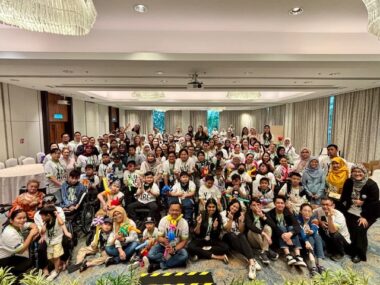
Duchenne families from all over Malaysia attend a family workshop hosted by Sabah Women and Children Hospital in August 2025. (Courtesy of Neil Brandom)
“The path toward finding a cure for Duchenne begins with the courage of patients and their families willing to participate in a clinical trial,” Catherine said. Our son participated in one of the earliest trials in the U.S. 18 years ago, when he was 14.
Puspa Rajah Palasingam, the father of Adithiyaa, a 10-year-old with Duchenne from Ipoh, the capital of the state of Perak, told me that parents in Malaysia just want the “same chance” that boys in other countries have.
“It gives us hope to see Malaysia being included in these conversations and efforts,” he said.
The petition and the growing parent-led movement are supported by the Malaysian Rare Disorders Society.
“Our slogan is ‘advocate, collaborate, and enable,’” Nadiah Hanim Abdul Latif, the society’s president, said.
“We are here,” Catherine said in a recent interview on the Malaysian radio station BFM 89.9. “Boys and men with Duchenne in this region need a voice. Their care has improved significantly due to a new generation of doctors. We are ready to partner, participate, and make a difference. And doing trials here benefits those with Duchenne all around the world.”
To submit your own Guest Voice for publication on Muscular Dystrophy News Today, please email your idea to our columns manager at [email protected] with the following included in the subject line: “Guest Voice: Muscular Dystrophy News.”
Note: Muscular Dystrophy News Today is strictly a news and information website about the disease. It does not provide medical advice, diagnosis, or treatment. This content is not intended to be a substitute for professional medical advice, diagnosis, or treatment. Always seek the advice of your physician or another qualified health provider with any questions you may have regarding a medical condition. Never disregard professional medical advice or delay in seeking it because of something you have read on this website. The opinions expressed in this column are not those of Muscular Dystrophy News Today or its parent company, Bionews, and are intended to spark discussion about issues pertaining to muscular dystrophy.