MDA 2026: Dyne therapy boosts strength, cognition in DM1
'These patients are getting stronger'
Written by |
Myotonic dystrophy type 1 (DM1) patients in a Phase 1/2 clinical trial saw gains in motor function and cognitive measures after receiving Dyne Therapeutics’ zeleciment basivarsen (z-basivarsen), previously known as DYNE-101, supporting the recent initiation of a Phase 3 study.
Findings from the Phase 1/2 ACHIEVE trial (NCT05481879) and the design of the HARMONIA Phase 3 study were presented at the 2026 Muscular Dystrophy Association (MDA) Clinical & Scientific Conference, held March 8-11 in Orlando, Florida, and online.
Douglas Kerr, MD, PhD, the company’s chief medical officer, said Dyne didn’t initially know whether z-basivarsen would simply slow disease progression or if it could actually lead to functional improvements.
“What we’ve seen so far suggests it is the latter,” Kerr said in an on-site interview with Muscular Dystrophy News Today. “In other words, these patients are getting stronger … less fatigued, faster, able to think more clearly. So all of those are, in a sense, kind of reversing the disease, which is very gratifying, and from the patient perspective, they are extremely excited about this.”

Trials enrolling patients at sites around world
ACHIEVE is still enrolling adults with DM1 ages 18-65 at sites in the U.S., Europe, the U.K., Australia, and New Zealand.
Sites are also being initiated for HARMONIA, which will run globally and include about 150 people with DM1, ages 16 and older, who can complete certain functional assessments independently. Kerr said the study is “ready to go,” and Dyne is “anxiously trying to get patients to enroll.” Those interested can email Dyne.
The company hopes that data from ACHIEVE will support an application for accelerated U.S. approval of z-basivarsen sometime next year, and that data from HARMONIA will eventually support conversion to full approval, as well as approvals in areas outside the U.S.
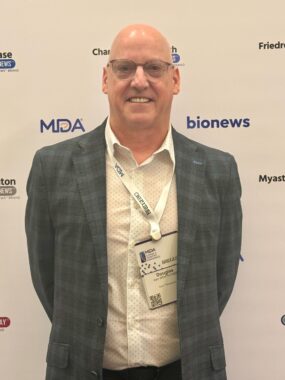
Douglas Kerr, MD, PhD, chief medical officer for Dyne Therapeutics, is shown at the MDA conference. (Photo by Kellie Benn)
DM1 is a multisystemic form of muscular dystrophy for which there are no approved therapies. Beyond the hallmark MD symptoms of muscle weakness, wasting, and myotonia (difficulty relaxing muscles), people with DM1 can have symptoms that affect various other tissues, including the brain.
The disease is caused by mutations in the DMPK gene. Normally, for the information in a gene to be translated into a functional protein, it’s first copied into a template molecule called messenger RNA.
In DM1, the faulty DMPK gene results in an abnormally long messenger RNA molecule that forms toxic clumps in cells. There, they interfere with a type of RNA processing called splicing, which affects the usual activity of many other genes.
“Myotonic dystrophy is, at its core, an RNA problem,” Kerr said. “It causes altered splicing of genes that help organs function, and so when those misspliced genes are in skeletal muscle, cardiac muscle, in the heart, those organs don’t work well.”
Z-basivarsen is designed to clear the problematic RNA clumps and correct this splicing issue. It contains a small piece of genetic material that binds to the clumps and causes their breakdown, attached to an antibody fragment that guides the therapy to muscle and brain cells.
By correcting the splicing problem, scientists at Dyne “had hoped and have now shown … the organs and tissues work better, and patients get stronger and faster,” Kerr said.
The first part of ACHIEVE tested various dosing regimens of z-basivarsen, given via infusions into the bloodstream, in adults with DM1, ages 18-49.

Patients ‘can be more independent’
In a poster at the MDA meeting titled, “Zeleciment basivarsen targets the underlying cause of DM1 to enable functional improvement in the Phase 1/2 ACHIEVE trial,” scientists focused on one-year data from the group of people who received a 6.8 mg/kg dose, given once every eight weeks — the regimen that’s now been selected as the optimal dose for future clinical testing.
In addition to showing signs of correcting the underlying splicing defect, z-basivarsen led to functional improvements relative to placebo across several clinical measures, including the video hand opening time (vHOT) test, an assessment of hand myotonia. Other measures of muscle strength and of upper and lower limb function showed similar improvements.
“In multiple aspects, patients are getting better on [z-basivarsen],” Kerr said. “What that translates to is they can be more independent in their home, they’re stronger, they can pick objects up, they can brush their teeth.”
Beyond objective measures of function, investigators had trial participants complete the myotonic dystrophy health index (MDHI), a patient-reported measure of disease burden that spans 17 areas of health relevant to DM1.
The data overall showed a “very robust reduction in the burden of disease as perceived by the patient,” Kerr said.
Benefits were observed in MDHI domains related to mobility, daily activities, and upper limb function, as well as in all six evaluated areas of neurological function: cognition, sleep, fatigue, communication, emotional issues, and pain.
Neurological symptoms are an aspect of DM1 that patients find particularly troublesome in daily life, but which aren’t always thoroughly evaluated in clinical trials.
“It’s not only the physical manifestations, but patients are fatigued,” Kerr said. “They fall asleep in the middle of the day. Their circadian rhythm [internal clock] is off. They have cognitive fatigue, and it’s really a very burdensome aspect of the disease.”
That z-basivarsen can get into the brain and effectively target these symptoms “is very gratifying to us,” Kerr said.

Company hopes trial results support accelerated approval
Overall, more than three-quarters of patients and clinicians perceived the clinical status as much or very much improved after a year on z-basivarsen at the selected dose.
Kerr also said z-basivarsen has had a “very good and favorable” safety profile, with more than 1,000 doses administered so far.
ACHIEVE is now enrolling an additional group of about 60 participants, ages 18-65, to further evaluate the selected dosing regimen. The main goal is to evaluate changes in vHOT performance after about six months.
Dyne hopes the data will support an application for accelerated U.S. approval of z-basivarsen sometime next year.
Accelerated approval is a pathway through which a therapy can earn conditional marketing authorization based on preliminary evidence of its safety and efficacy. To transition to a full approval, more clinical data on its benefits for patients is still needed. That confirmatory data is expected to come from HARMONIA.
Kerr talked about HARMONIA’s design — developed in partnership with the DM1 community — in a presentation titled, “A Global Phase 3 Trial Assessing the Efficacy and Safety of Z-basivarsen in Myotonic Dystrophy Type 1.”
Participants will be randomly assigned to receive either z-basivarsen (6.8 mg/kg) or a placebo once every eight weeks for about a year. After that, all participants will receive z-basivarsen in a long-term extension phase.
HARMONIA won’t be using vHOT as its primary outcome measure. While vHOT is a reliable way to detect change in a relatively short time, it isn’t the most functionally meaningful outcome for patients, nor is it applicable to daily life activities, according to Kerr.
Instead, HARMONIA will rely on the Five Times Sit-to-Stand (5xSTS) test, which measures how long it takes a person to stand up from a chair and sit back down again, five times in a row. This test is a better measure of a person’s ability to perform daily activities independently, Kerr says.
“It is the kind of activity that a patient does in his or her own home every day, up and down, in the kitchen, in the living room, things like that,” he said. “ So it is intrinsically meaningful in terms of what a patient can do in their own home.”
5xSTS performance is also a predictor of falls, which is important because people with DM1 are at a much higher risk of falls than healthy people, often leading to injury and disability. The test also engages the trunk muscles needed for breathing, which is important because respiratory failure is a leading cause of death in DM1.
For all these reasons, Dyne sees 5xSTS as “a very meaningful endpoint,” Kerr noted.
Other trial endpoints will further assess DM1’s multisystem impact, including its neurological effects. Cognition, emotional issues, sleep, and fatigue will all be evaluated across a series of tests to “really clarify what we think we’re seeing from ACHIEVE,” said Kerr.
When asked what it would mean for patients with DM1, currently without any approved disease-modifying therapies, to have an option like z-basivarsen, Kerr responded: “I think it would mean an awful lot.”
“This is a disease that is life-shortening, impacts patient strength, function, ability to work, ability to think, and so we set about really addressing all of those so that patients could resume a more normal life.”
Note: The Muscular Dystrophy News Today team is providing live coverage of the 2026 MDA Clinical & Scientific Conference March 8-11 in Orlando, Florida. Go here to see the latest stories from the conference.