
Skip to content
Muscular Dystrophy News logo
Newsletter
  • About MD
    Muscular dystrophy overview
    • Causes
    • Symptoms
    • Diagnosis
    • Life expectancy
    Treatments
    • Approved treatments
    • Experimental treatments
    • Non-drug treatments
    Types
    • Becker muscular dystrophy
    • Bethlem myopathy
    • Congenital muscular dystrophies
    • Duchenne muscular dystrophy
    • Facioscapulohumeral muscular dystrophy
    • Limb-girdle muscular dystrophy
    • Myotonic dystrophy
    • Tibial muscular dystrophy
  • Living with
    Living with muscular dystrophy
    Exercise and physiotherapy
    Diet
    Breathing difficulties
    Heart problems
    Joint care
    Support and resources
    Assistive technology
    Speech therapy
  • Community
    Perspectives
    • Duchenne: Shalom’s Lifelong Partner-in-Crime — Shalom Lim Ern Rong
    • Muscle Memoirs: LGMD Experiences — Patrick Moeschen
    • Party of 9 — Betty Vertin
    • Working Through the Process — Robin Stemple
    More Perspectives
    • Bloom – Prudence Jones
    • Hawk’s-Eye View – Hawken Miller
    • Hidden Truths – Adeel Rizvi
    • Of Dragons and Dystrophin – Andy Rusch
    Guest Voices
  • News
  • Forums
  • Resources
    Video & Podcasts
    • Treatment risks and uncertainty
    • Setting boundaries with caregivers
    • Overcoming discomfort
    • Finding motivation
    • Mental health support
    Featured Topics
    • Caregiver’s guide to DMD
    • Adaptive living
    • Navigating DMD
    Advocacy partners
    Clinical & Scientific Conference Coverage

Cardiac disease in Duchenne

Gowers’ maneuver

Early clues

Turning point

See more videos

Daniel Guillen, MD, explains how DMD affects the heart muscle and why cardiac disease often progresses quietly over time. Learn why heart complications may go unnoticed in boys with Duchenne and why ongoing cardiac monitoring is essential.

Why is cardiac involvement often called the ‘silent threat’ in DMD?

Transcript

So we have to remember that the cardiac muscle is a muscle and there is dystrophin expression in it. And the problem with the boys and when they start developing their cardiac symptoms is that they are also starting to lose ambulation at that age.

Read More

So you may not notice as much typical cardiac symptoms like you do in adults. You go for a longer walk or you start running. You feel your chest pounding, you’re short of breath. You may have chest pains.

That is not something that necessarily boys with Duchenne are going to notice, because at the time they’re developing the cardiac disease, they are not running around as much. They are not going up and downstairs. They are not doing that level of physical activity.

The other concern is that that may be progressive over time. The cardiac muscle is still going to be contracting and relaxing all the time, regardless of whether we’re exercising or not.

And we do have progression of cardiac muscle disease over the years, with a number of patients even presenting subtle findings before 10 years of age. And I would ask a cardiac colleague this same question, but they tend to develop worsening cardiac diseases. Years go by, and sadly, this seems to be the leading cause of mortality once they become young adults.

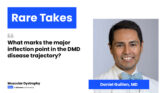
The major turning point in Duchenne progression
Early clues that can point to Duchenne
The Gowers’ maneuver in Duchenne
See more videos

  Subscribe to our newsletter

Get regular updates to your inbox.

This field is for validation purposes and should be left unchanged.

Bionews Logo Bionews, Inc.

3 W Garden St
Suite 700
Pensacola, FL 32502
Website: bionews.com
Email: [email protected]
Phone: 1-800-936-1363

  • Muscular Dystrophy News on Facebook
  • Muscular Dystrophy News on X
  • Muscular Dystrophy News on Instagram
  • Muscular Dystrophy News on Pinterest
  • About Us
    • Our Culture
    • Leadership
    • Careers
    • Contact Us
  • Explore More
    • Advertising Policy
    • Corrections Policy
    • Editorial Policy
    • Privacy Policy
    • Terms of Service
Disclaimer

This site is strictly a news and information website about the disease. It does not provide medical advice, diagnosis or treatment. This content is not intended to be a substitute for professional medical advice, diagnosis, or treatment. Always seek the advice of your physician or other qualified health provider with any questions you may have regarding a medical condition. Never disregard professional medical advice or delay in seeking it because of something you have read on this website.

Copyright © 2013-2026 All rights reserved.

Log in

Don't have an account?

Log in

[wppb-login register_url="/register" lostpassword_url="/recover-password" ajax=true]

|

Register

Already have an account?

Register

Create your account by filling in the information below:

[wppb-register redirect_url="/welcome" ajax=true]

By creating an account, you are agreeing to the Privacy Policy and Terms of Service.

Reset Password

[wppb-recover-password ajax=true]