
I almost lost my garden to Becker MD. One tool brought it back.
How an MDA equipment grant changed everything for me
Written by |
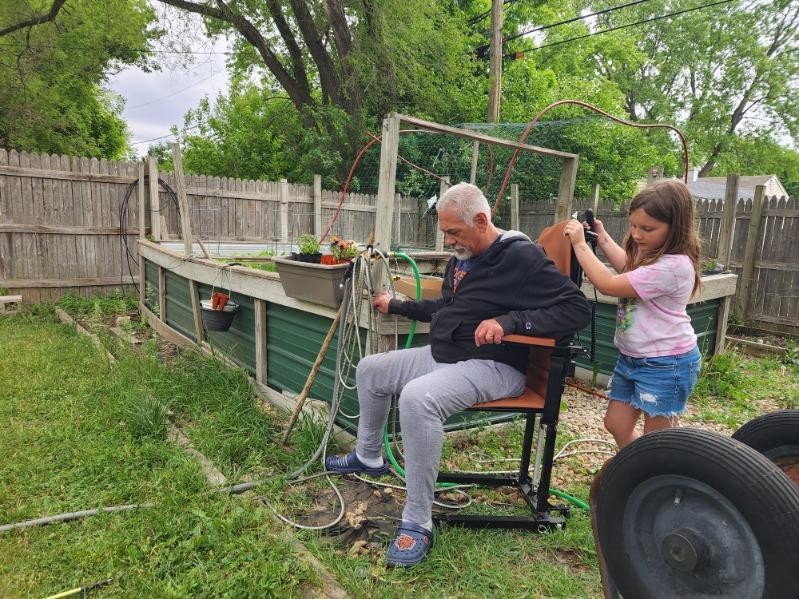
After Chuck Vrasich fell in the garden, his granddaughter helped him get back up with the chair lift he was able to get with support from the MDA Durable Medical Equipment grant. (Courtesy of Chuck Vrasich)
There’s a certain rhythm to gardening that I’ve always loved. The early mornings, the quiet work of turning soil, the satisfaction of seeing something grow because you cared for it. In my backyard, I’ve built raised beds filled with vegetables and herbs — nothing fancy, but enough to keep my hands busy and my mind at ease.
Living with Becker muscular dystrophy means I’ve had to adjust how I do a lot of things over the years. Gardening is no exception. I’ve learned to pace myself, to take breaks, to work smarter instead of harder. But there’s one thing I haven’t been able to fully control: falling.
“I tend to fall.”
It’s a simple sentence, but it carries a lot with it. For me, a fall isn’t just inconvenient — it can be frustrating, even a little frightening. The hardest part isn’t always the fall itself; it’s what comes after. Getting back up isn’t something I can do easily on my own anymore.
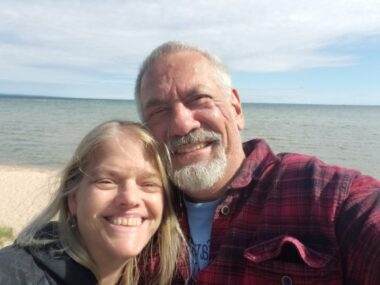
Chuck and his wife Sherri, raised five children and now enjoy time with their five grandchildren. (Courtesy, Chuck Vrasich)
For a long time, that meant relying on someone else to help me up. And while I’m grateful for the support, it’s not always ideal. You start to feel like you’ve lost a bit of independence, a bit of control over your own day.
That’s why something as simple as a piece of equipment can make such a big difference. I first heard about the Muscular Dystrophy Association’s (MDA) Dura
ble Medical Equipment Grant Program through my MDA care team. They mentioned it in passing, as one of those resources that might be worth looking into. At the time, I wasn’t sure if I’d qualify or if it would be a complicated process. A lot of programs sound helpful until you actually try to apply.
But this one was different.
Once I gathered the basic information, the application itself took me maybe 20 minutes. That was it. No piles of paperwork, no jumping through hoops. Just straightforward questions to understand what I needed and why.
For me, that need was a lightweight floor-to-stand lift.
It’s not a big, complicated machine. In fact, that’s part of what makes it so useful. If I fall, someone can bring it over, I can position myself onto it, and it helps me get back to standing. It gives me a way to recover without feeling stuck or completely dependent on someone else’s strength.
When the lift arrived — less than a month after I applied — it felt like a small victory. Not in a dramatic, life-changing way, but in the quiet, practical sense that matters just as much. It meant I could spend time in my garden with a little more confidence. It meant that a fall didn’t have to derail my entire day.
Programs like this work because they’re built around real needs. The application asks just enough to understand your situation, and the documentation is minimal —things like a quote for the equipment you’re requesting. From there, the process moves quickly. Approvals can come within a day or two once everything is submitted, and then it’s just a matter of waiting for the equipment to arrive.
That kind of efficiency matters more than people might realize. When you’re dealing with a progressive condition, delays can mean missed opportunities to maintain your independence or prevent further complications. Having access to support that’s both practical and timely makes a real difference.
Chuck enjoys growing herbs, vegetables and flowers – but the threat of a falling and not being able to get up impacted his confidence working outside. The lift changed that. (Photo courtesy Chuck Vrasich)
For me, it comes back to those moments in the garden. Being able to focus on what I’m planting instead of worrying about what might happen if I fall. Being able to get back up and keep going. It’s a small thing, maybe, but it adds up. We don’t always think about independence in terms of equipment. We think about it as something bigger — mobility, careers, major life decisions. But sometimes, independence looks like having the right tool nearby when you need it. Sometimes it’s about making sure a setback doesn’t turn into a stopping point.
I still fall from time to time. That hasn’t changed. But what has changed is what happens next.
Now, I have a way to get back up. And that’s made all the difference.
This article was provided by our partner, the Muscular Dystrophy Association. It has been reviewed by Bionews for accuracy and relevance. The views and opinions expressed are those of the author and do not necessarily reflect the views of Bionews or Muscular Dystrophy News Today.
