Honoring the life and legacy of my brother, who had LGMD
Written by |
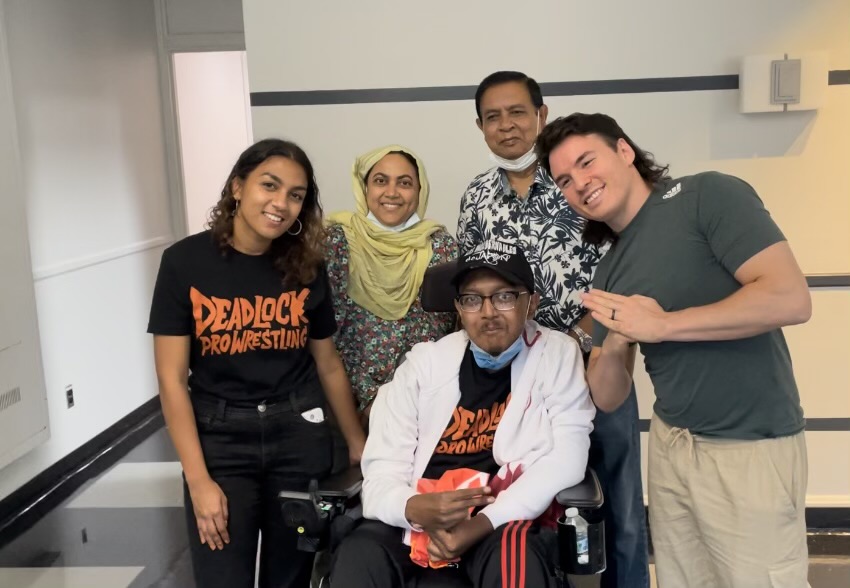
Anjar Hossain, center, and his family (from left, Rayna Haque, Seyada Jahan, and Mohammed Haque) pose with wrestler Mike Bailey at a meet-and-greet organized by Deadlock Pro-Wrestling and Duke Palliative Care in 2023. (Photos courtesy of Rayna Haque)
In recognition of Muscular Dystrophy Awareness Month in September, the Muscular Dystrophy Awareness Month campaign features a series of stories highlighting the real-life experiences of people affected by muscular dystrophy, written in their own words. Follow us on Facebook, Instagram, or X for more stories like this, using the hashtag #MDAwarenessMonth, or read the full series.
My fondest memories with my brother, Anjar, were beside a wrestling ring. Yes, the kind with performers in tights and elaborate costumes, executing feats of strength and gravity-defying acrobatics that left both the wrestlers and the audience covered in blood and sweat.
It was a tradition we somehow maintained while I was in medical school and he was working at the Alliance of Disability Advocates. I would occasionally request a less visible seat so I could do flashcards between matches, clap whenever I heard the crowd erupt, and look up in time to pretend I had been paying attention. He would roll his eyes and tease me for being a nerd, but he never made me feel guilty. He understood how much school demanded of me, just as I understood how much those nights together meant to him.
I was always surprised at how easily he struck up conversations with the wrestlers after a match, congratulating them on their performances. He loved making people feel seen. I knew this better than anyone, since he was the first person to congratulate me on even the smallest accomplishment.
My brother was also a passionate advocate who cared deeply about the intersections of disability and other minoritized identities. As a community inclusion specialist with a background in social work, he helped people navigate inaccessible systems and resources, working to preserve their autonomy. He challenged those around him to think beyond disability and toward the systems that create barriers in the first place.
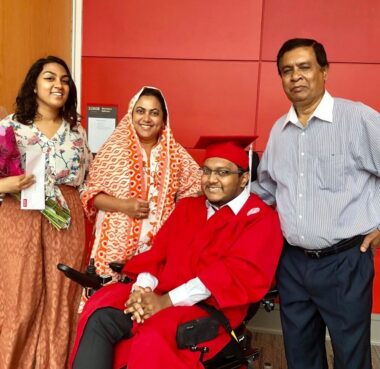
From left, Rayna Haque, Seyada Jahan, Anjar Hossain, and Mohammed Haque attend Anjar’s college graduation in 2019.
Anjar had limb-girdle muscular dystrophy type 2I, a rare variant affecting cardiac and pulmonary muscles that eventually led to his heart transplant at 17. The transplant gave us another decade together, but came with its own lifelong complications. Years of immunosuppression led to kidney failure requiring thrice-weekly dialysis, followed by pancreatitis-induced diabetes, restrictive lung disease, and, ultimately, a rare post-transplant lymphoma.
Anjar, like many people living with a combination of rare and serious illnesses, was intensely aware of his own mortality. Nothing, however, could have prepared us for his death at 29 in 2024.
I struggle when people frame my brother’s life as the reason I entered medicine or as a lesson that will make me a better physician. I was a sister long before I joined this field.
Too often, people with disabilities are presented as either tragedies or extraordinary sources of inspiration. Both narratives can flatten a complicated human life. Anjar experienced pain, frustration, dependence, and fear. He also experienced pride, humor, purpose, love, and joy.
His experiences and advocacy nonetheless shaped my understanding of healthcare. What else did my brother teach me? To question systems that present inequity as inevitable. To listen to disabled people as experts in their own lives. To recognize that independence does not mean never needing help and that vulnerability does not diminish a person’s dignity.
Anjar also taught me SAT vocabulary. How to lose gracefully after he beat me for the seventh time in a video game. How to deliver a punchline so dry no one can tell if they’re supposed to laugh.
Near the end of his life, in a video recorded with a local wrestling promotion and his palliative care team, Anjar shared his advice for others in his position: to find “anything that brings joy” and allows them to “look forward to life outside of the hospital.”
When I think of my brother, the first thing that comes to mind is still professional wrestling: the dramatic entrances, deafening crowds, and him sitting beside me, absorbed in the spectacle. I remember him pushing through the post-dialysis exhaustion just to get to shows. I remember cheering until our voices were hoarse.
At the end of the day, I lost my best friend, and the world is far worse without him. I hold on to these memories as a reminder that his life was defined by how wholly he loved, rather than solely by what he endured.