
MDA Engage: ‘I am not alone’ was the biggest takeaway in Chicago
Rare disease families gather to share medical updates and peer support
Written by |
For many people living with rare neuromuscular diseases, the most meaningful part of a recent Chicago gathering was not just the medical updates — it was finding a community that understood their daily struggles.
The realization that they were not alone set the tone for MDA Engage: Chicago, a free symposium held Sept. 26 in suburban Lombard. The daylong event brought together families, advocates, and neurologists to share clinical updates, practical living strategies, and peer support.
Carlos Lara, MD, a board-certified neurologist and assistant professor of neurology at UChicago Medicine, heard some version of the same question from attendees all day: “Why am I struggling with this?”

Finding connection in a shared journey
Lara treats people with myasthenia gravis, an autoimmune disease that causes muscle weakness. He noted that many patients had spent years feeling isolated in their health journeys, making the event’s peer connections deeply validating.
“I would say that’s one of the biggest themes: validation,” he said.
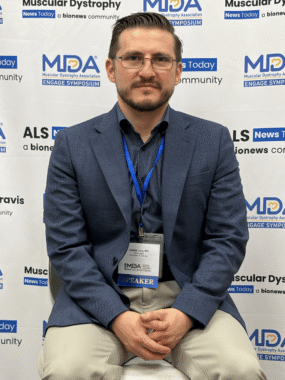
Carlos Lara, MD, is a board-certified neurologist and assistant professor of neurology at UChicago Medicine. (Photos by Douglas Backstrom)
Rabia Malik, MD, gave the welcome address, followed by keynote speaker Mindy Henderson, who lives with spinal muscular atrophy (SMA). Malik directs the MDA Care Center at Rush University Medical Center, where she is also an associate professor of neurological sciences. She hopes the symposium becomes an annual event in Chicago.
The Muscular Dystrophy Association (MDA) supports individuals with more than 300 rare neuromuscular conditions, Malik noted. Because many of these conditions affect small populations, meeting someone with the same diagnosis in everyday life can be rare.
That is why conversation breaks between presentation sessions proved just as important as the lectures. Attendees came to hear about new research, but they spent breaks swapping practical tips and learning from one another’s lived experiences.
“Everyone is thirsting for knowledge,” Malik said. The challenge is reaching “every single individual in the community.”
The symposium kicked off with Henderson’s keynote address, in which she offered an inspiring message: limits are real, but they don’t have the final say.
Henderson was diagnosed with SMA at 15 months old. At the time, doctors told her parents there were no cures, no treatments, and no reason to even pursue physical therapy. They were also told that she would never walk and probably would not live past age 3. Her parents thanked the doctors, went home, and pursued physical therapy regardless, sparking a lifelong mindset for Henderson.
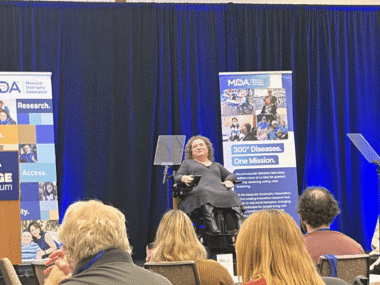
Keynote speaker Mindy Henderson speaking at MDA Engage: Chicago.
“There’s a difference between a limitation and a conclusion,” Henderson said. “A limitation may be real. But a conclusion is what we decide that limitation means. And those are not always the same thing.”
Henderson’s fear of injury and wheelchair damage kept her off airplanes for 14 years. An MDA invitation to Capitol Hill to advocate for accessible air travel got her flying again. That advocacy is now part of her job.
Children today are reaching milestones their parents were told not to expect, she said. “A diagnosis can describe a condition. It can’t calculate a future.”
Practical tips for everyday health
The symposium also addressed practical daily concerns, with sessions covering topics such as diet, bone health, bracing, travel tips, and ways to adapt daily tasks like getting dressed.
To make the most of clinic visits, Malik urged patients to arrive organized with printed medical records, genetic testing results, and recent clinic notes. She also encouraged asking for referrals to multidisciplinary teams, such as registered dietitians or physical therapists, to address holistic health needs in a single visit.
“You’d be surprised that when you go and meet a new physician, they may not have access to all the testing that has been done already,” she said.
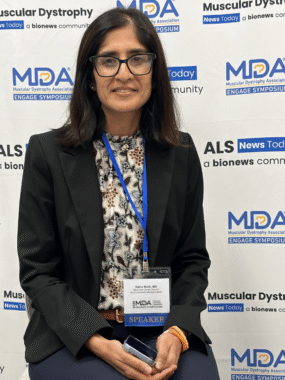
Rabia Malik, MD, is the director of the MDA Care Center at Rush University Medical Center.
Lara warned patients against modifying prescription medication doses on their own, even when feeling well. He also encouraged patients to ask about emerging options like CAR T-cell therapy, a cutting-edge treatment that genetically reengineers a patient’s own immune cells in a laboratory so they can target and destroy the specific immune cells driving disease.
Both physicians noted a growing trend of patients using artificial intelligence (AI) tools like ChatGPT to research symptoms before appointments. While both doctors support using AI to brainstorm questions, they cautioned patients to verify all medical findings with their care team.
“As a medical professional, or somebody who is well versed within a certain topic of neuromuscular medicine — for me, it may be a little bit easier to pick out what is accurate versus what … may be a little bit inaccurate,” Malik said. “Always run things by your neuromuscular specialist.”
Lara agreed. AI can point people in the right direction, he said, but it should not make medical decisions.
“Bring those questions here,” he said.
Note: The Muscular Dystrophy News team is providing coverage of the MDA Engage Symposium. Go here to see the latest stories from the conference.

Leave a comment
Fill in the required fields to post. Your email address will not be published.