
MDA Engage: Patients belong at the start of drug development
Panel discusses ways patients, doctors, advocates can influence care
Written by |

People living with neuromuscular diseases and their families should help shape new treatments from the very start, rather than weighing in only after key decisions are made, according to experts and community members who spoke on a Sept. 26 panel at the MDA Engage: Chicago symposium.
The panel, “Building Better Treatments Together,” focused on how patients, clinicians, drugmakers, advocacy groups, insurers, and government health agencies can influence treatment development and care. MDA Engage brought together people living with neuromuscular diseases, their caregivers, clinicians, and advocates for education and community support.
Christina Trout, an advanced practice nurse in Genentech’s neuromuscular program, described the long path from the laboratory to the clinic. Potential treatments are usually tested first “either on cells or on animals, and by animals I’m talking about mice, rodents, monkeys and so on,” Trout said. “So there’s a big leap between going from that model into humans, and we’re always minding that safety.”
Even after a new therapy is cleared for testing in people, clinical trials can take several years to complete, Trout said. Researchers must evaluate a treatment’s safety and potential benefits before a company submits evidence to the U.S. Food and Drug Administration (FDA) for review and potential approval.
Noah Brown, a general manager at Amgen, said trials generally move through three phases built around answering a few basic questions: “Are the medicines safe, or safe enough anyway, to merit their study in a larger population? And are they effective? Do they actually provide a clinical benefit to the patients receiving them?”

A mother’s frustration
Gabriela Valera, the mother of two boys with Duchenne muscular dystrophy, said she became an advocate after finding no support groups for Latino families.
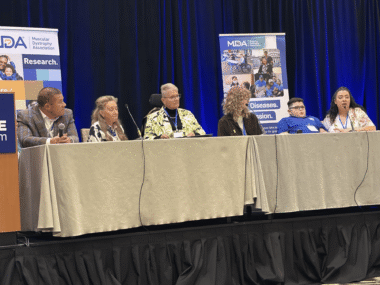
Panelists speak during the MDA Engage: Chicago symposium. (Photo by Douglas Backstrom)
She said she learned while pregnant with her younger son, Sebastian, that she carries a Duchenne-causing genetic variant, although she knew of no family history of the condition. Sebastian was tested when he was 6 months old.
Valera said she had hoped her older son, Giovanni, who sat alongside her on the panel, could receive a gene therapy that was being tested at the time, to allow him to “walk longer … to get more time.”
But when the therapy, Elevidys (delandistrogene moxeparvovec-rokl), was approved, it was limited to 4- and 5-year-olds, and Giovanni was almost 7 by then.
“I was very upset, because they didn’t consider all these children who were waiting for this treatment to get approved,” she said.
Sebastian, who attended the session, was 4 when he received the gene therapy at a hospital in Detroit. Valera said he was the first child to receive it there. Giovanni was the second, as the approval was extended to older children about a year later.
“If they would have just done it in the beginning and approved it for any age, I feel like it would have saved a lot of children, to be able to walk longer,” she said.
Valera said families should be asked for their views before such decisions are made.
“Some of us will sometimes take a risk if it’s going to be more beneficial for our children,” she said. “We are already taking risks taking other medications.”

Patients as the experts
Brown said patients were long treated “as an afterthought” in research driven by medical experts and industry scientists. That has changed, he said.
“In recent years, particularly in rare diseases, I think we’ve come to realize that the patients are the experts in these conditions,” Brown said. “And so it’s critical that we’re assessing the medicines and how they work in ways that are clinically meaningful, not just to the medical experts, but also to the patients living with these conditions every day.”
Community member Liza Shyrochyna, another panel member, said patients often don’t know how to get involved or where their voices can be heard. She wants patients included earlier, especially when researchers decide which trial results matter.
“Something that looks like a small improvement clinically on paper might make a big difference in someone’s everyday life,” she said.
Patient voice “means that patients aren’t just asked for feedback after decisions have already been made,” Shyrochyna said. “It means involving us early enough that our experience can actually influence those decisions.”
Trout said one valuable way families can contribute is by participating in natural history studies. These studies follow people to see how a disease naturally evolves over time.
“It doesn’t seem very flashy initially,” Trout said, but these studies can help researchers understand the expected course of a disease and whether a treatment being tested in clinical trials may be making a meaningful difference.
For Valera, the message to families is simple: Start now.
“We as parents, we have to advocate more for the children,” she said. “We have to speak out and educate ourselves. We need to be more involved in testing the treatment, because who is it going to affect? Our children.”
Note: The Muscular Dystrophy News Today team is providing coverage of the MDA Engage Symposium. Go here to see the latest stories from the conference.


Leave a comment
Fill in the required fields to post. Your email address will not be published.