Duchenne advocate uses his podcast to go beyond the disability community
Written by |
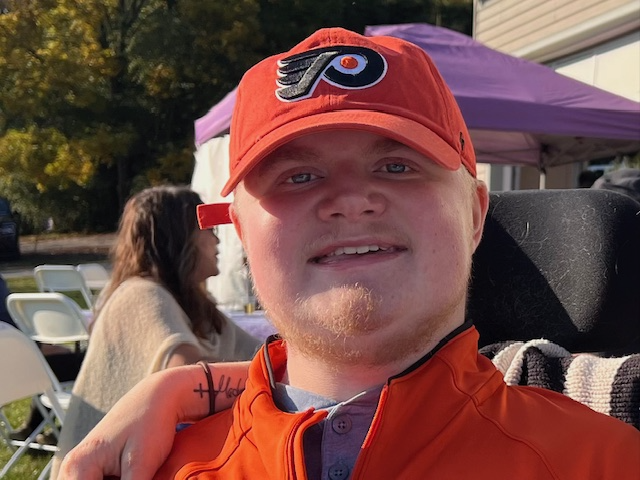
Elliott Johnson saw advocacy in action in high school when he attended his first conference for people with muscular dystrophy. (Photos courtesy of Elliott Johnson)
In recognition of Muscular Dystrophy Awareness Month in September, the Muscular Dystrophy Awareness Month campaign features a series of stories highlighting the real-life experiences of people affected by muscular dystrophy, written in their own words. Follow us on Facebook, Instagram, or X for more stories like this, using the hashtag #MDAwarenessMonth, or read the full series.
When I was 4, I was diagnosed with Duchenne muscular dystrophy, a neuromuscular muscle-wasting condition. The first few years after diagnosis, I knew very few boys with the same condition, nor other disabled people, for that matter.
It wasn’t until high school that I attended my first Parent Project Muscular Dystrophy (PPMD) conference, where I met plenty of other individuals living with Duchenne or with Becker muscular dystrophy, many of whom are now close friends and mentors of mine. In addition to these connections, the conferences taught me that self-advocacy did not end with a move away from home.
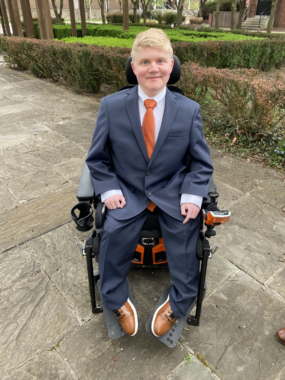
Johnson now cohosts a disability podcast with an able-bodied friend, with the goal of reaching a wider audience.
Fast-forward to college: Already familiar with self-advocacy, I was comfortable advocating for myself without the safety net of my parents. I alone had to communicate with my friends, caregivers, professors, and the school to ask for the help I needed.
During my junior year, the university was willing to give some of my friends housing in wheelchair-accessible dorms. Additionally, the chair of the audio production program in which I was getting my degree worked with facilities and me so I could access the console in the post-production studio. It was here that I discovered my voice could instill change in the world around me.
After this discovery, I decided to use both my voice and the audio production skills I developed throughout college to create my own disability podcast.
Throughout the course of my life, I have realized that disability is not a part of mainstream conversation and instead is a topic primarily discussed in the context of disability communities. This is not to say that these communities aren’t making an impact in the world, especially for those living with disabilities.
Yet outside of that, disability awareness is often limited for those without a direct connection. For example, many of the accommodations I asked for in college were first-time requests.
Many of the disability podcasts in existence today are created with disabled listeners in mind, thus resulting in an exclusively disabled audience. By bringing my able-bodied friend in as a cohost and injecting more storytelling and humorous elements, the show can reach people who would not typically listen to a podcast centered around disabled stories. Listen to “Adaptive AF: Disability Unfiltered” wherever you listen to podcasts, and follow on social media (Instagram) @adaptive.af_pod.66 and (TikTok) @adaptive.af.
The advocacy I admired at my first PPMD conference now looks different from what I imagined as a child. While policy advances and research are crucial, I believe changing public perception is just as important. Through audio production, podcasting, and continued involvement with the Duchenne and Becker community, I hope to help create a future where disability is understood not through stereotypes or inspiration, but through real stories and voices.