
MDA Engage: Treatments for muscular dystrophy show promise, face hurdles
Neuromuscular specialists discuss recent developments in DMD. LGMD, FSHD
Written by |
New treatments for muscular dystrophy (MD) are moving forward, but no single therapy will work for every MD type, and some promising therapies have fallen short in trials, two neuromuscular specialists told patients and families.
“Muscular dystrophies are not just one condition,” said Ryan Jacobson, MD, a neuromuscular specialist at Rush University Medical Center in Chicago. “So there’s not going to be one type of treatment for all of them.”
Jacobson presented the session, “New Treatments for Muscular Dystrophy,” along with Colin Fry, MD, a neuromuscular specialist at University of Chicago Medicine. The session took place Sept. 26 during the MDA Engage: Chicago symposium.

DMD: Gene therapy gains and limits
Duchenne muscular dystrophy (DMD) is the most common type of MD, affecting about 1 in 3,500 male births, according to Fry. It is caused by mutations in the DMD gene that encodes dystrophin, a protein that acts like a shock absorber when muscles contract.
Corticosteroids and exon skipping therapies remain the primary treatments.
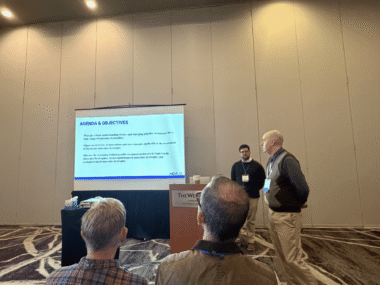
Ryan Jacobson, MD, (right) and Colin Fry, MD, make a presentation at MDA Engage. (Photo by Douglas Backstrom)
Gene therapy faces a size problem in DMD. The viruses used to deliver genes hold about 4.8 kilobases of genetic material, but the dystrophin gene is much larger, having about 14 kilobases.
“So how do we deliver such a large gene? Well, we can try and shrink it down,” Fry said.
Indeed, the solution was taking advantage of microdystrophin, which is essentially a smaller version of the dystrophin gene that holds instructions for making a shorter, but functional version of the dystrophin protein. The idea, according to Fry, was based on a patient with a milder form of DMD who had only one portion of the DMD gene affected and whose body produced a smaller, but functional, form of dystrophin.
Elevidys (delandistrogene moxeparvovec-rokl), the only approved microdystrophin gene therapy, is indicated for people with DMD ages 4 or older who can still walk. The high dose of viral vector required for treatment can trigger immune responses and cause toxic side effects. These safety concerns have slowed the development of similar therapies, according to Fry.
Researchers are now working on ways to overcome these challenges, including targeting muscles more precisely, which could help lower the viral vector dose needed for treatment.
“And that’s the hope for this kind of treatment to be more broadly used and potentially applied to other genetic muscle diseases,” Fry said.

LGMD: Early gains, slow progress
Limb-girdle muscular dystrophy (LGMD) includes more than 30 genetic subtypes, each of which may require a different treatment, according to Jacobson. One of those subtypes is LGMD type 2E (LGMD2E), which is caused by mutations in a gene that encodes a protein called beta-sarcoglycan, which is part of a protein complex that normally helps stabilize dystrophin proteins.
A gene therapy called bidridistrogene xeboparvovec (also known as SRP-9003) is currently being developed for LGMD2E. Data from an early trial testing the therapy in children with LGMD2E showed the treatment was safe and well tolerated, and able to increase the levels of beta-sarcoglycan protein in muscles. A larger Phase 3 clinical trial of the therapy is currently underway.
“Treatments like this are probably part of the future of limb-girdle muscular dystrophy. But this is an area of medicine where things have been pretty slow for the past couple of years,” Jacobson said.
FSHD: Failure and a new approach
Regarding facioscapulohumeral muscular dystrophy (FSHD), Jacobson talked about losmapimod, an oral therapy whose development was discontinued after it failed to show a clinical benefit in a Phase 3 clinical trial.
Losmapimod was a small molecule that worked to inhibit enzymes that regulate the activity of a gene called DUX4. The gene is abnormally turned on in FSHD, driving the production of the DUX4 protein in muscle cells where the protein shouldn’t normally be. This is believed to contribute to cellular toxicity and muscle damage.
“In the future, we will likely take more of a genetic-based approach to treating this disease as well,” Jacobson said.
An experimental RNA-based therapy, del-brax, which works to reduce the production of the DUX4 protein, may be the way forward. It has been shown to improve measures of muscle strength and quality of life in people with FSHD participating in an early trial. A Phase 3 clinical trial evaluating its safety and efficacy in FSHD patients is ongoing.
Note: The Muscular Dystrophy News Today team is providing coverage of the MDA Engage Symposium. Go here to see the latest stories from the conference.



Leave a comment
Fill in the required fields to post. Your email address will not be published.