
MDA Engage: The right assistive equipment can aid independence
Understanding goals, environment can help with choice
Written by |
The first step to figuring out the right equipment for someone with a neuromuscular disease like muscular dystrophy is to understand that person’s goals, environment, and changing needs, a pair of experts said.
“There’s a lot of equipment out there,” said Katie Metheny, an occupational therapist based in the Dallas area. “A lot of folks will buy things and think this is going to help them work, and then it does for a moment, and then we want something that lasts a lot longer.”
Metheny, who has worked in neurorehabilitation for more than 30 years, and Tom Simon, a certified assistive technology professional (ATP) with Numotion, co-presented a session on equipment and strategies for making activities of daily living easier for people with neuromuscular diseases at the MDA Engage: Dallas symposium. The Oct. 23-24 event brought together people living with neuromuscular diseases and their caregivers, along with clinicians and advocates, for education and community support.
Metheny and Simon, who works with clinics in Texas to help identify the most appropriate equipment for their patients, provided tips on tools aimed at facilitating daily living in a talk titled, “Finding the Right Equipment.”

The process starts with the person
The guiding principle for equipment decisions should be to fit the solution to the life, not the life to the equipment, Simon said.
“We’re going to start with the person and not the product,” Simon said. “How many times [has] someone tried to sell you something, but they don’t even ask you how you are or why do you need it or what your goals are?”
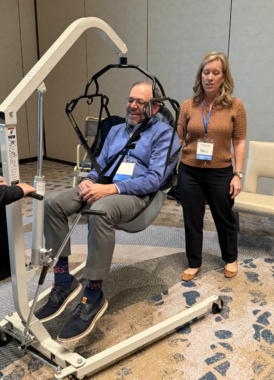
Tom Simon (left) and Katie Metheny (right) demonstrate the Hoyer hydraulic lift at MDA Engage: Dallas. (Photo by Tara Haelle)
Among factors to consider are a person’s current function, including strength, endurance, balance, posture, and movement ability, and personal goals, including safety, independence, comfort, and choice. For example, someone with Duchenne muscular dystrophy who can still walk may benefit from orthotic devices, canes, or walkers to support mobility, improve stability, or reduce fatigue. For those who can no longer walk, wheelchairs are an important piece of assistive equipment for maintaining mobility and independence.
Professionals helping a patient pick out appropriate equipment also need to take into account the person’s support system, including care partners, level of training or need for training, and backup plans if part of their support system falls through.
Another important part of the process, Simon said, is to anticipate change as much as possible, while recognizing that it’s not possible to perfectly predict what a patient might need next.
“We try to stay ahead of the curve, but we don’t know where the curve is at,” he said. “So what we as professionals try to do is not only take a snapshot of where you’re at today, but think about where you may be in the future.”
That includes thinking about the financial aspects of equipment and giving people options. Metheny said it’s also important to think about the patient’s environment. That includes the layout of their home, the transportation they use, where they work or go to school, and their community.
“And then, what are your personal goals?” Simon said. “Do you want to go to [the] grocery store? Do you want to have a mobility device that takes you to church, or do you want to just stay in your house all day? Whatever you want to do … It’s your choice.”

Options for individual needs
Simon and Metheny demonstrated several types of equipment to get attendees thinking about what they might need and what is likely to be covered by insurance. They covered six categories of equipment: mobility and positioning, transfers and lifting, bathing and toileting, daily activities and access, sleep and support surfaces, and transportation and portability.
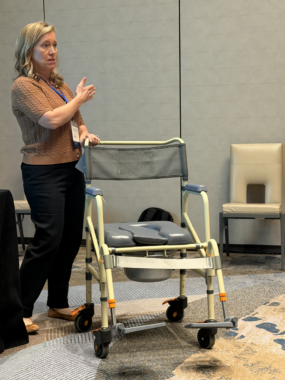
Katie Metheny shows a rolling shower and commode chair at MDA Engage: Dallas. (Photo by Tara Haelle)
They showed a medical-grade power wheelchair with features including a tilt that can take pressure off the buttocks and allow for improved blood flow. The chair can also recline and elevate, both to accommodate different needs someone might have in different situations. It also comes with cushion options to help reduce the risk of pressure sores.
Medical-grade wheelchairs should be covered by most insurance, according to Simon and Metheny. Patients can consider adding equipment to suit specific needs, such as a travel neck pillow to provide head support or a chest strap to prevent the torso from leaning forward, they said.
Simon demonstrated how to use a Hoyer hydraulic lift, a device designed by Ted Hoyer, who had quadriplegia, and his cousin to assist with transfers between beds, wheelchairs, and baths. Insurance does not cover electric Hoyer lifts, but usually covers manual ones, which can help caregivers avoid injury with transfers.
The pair also showed a rolling shower and commode chair, but noted that insurance usually won’t cover anything that gets wet for adults. Other assistive devices they mentioned for bathing and toileting included a portable bidet for toileting when away from home, an adjustable shower brush, and a French washcloth, which can be worn over the hand.
Questions to consider
Although each person’s needs will differ, there are some standard questions that can be helpful for everyone to ask their ATP.
“One of our biggest goals today was to empower you to ask to understand about equipment and how to get it,” Simon said.
He listed several questions that should be considered for any new piece of equipment, whether it’s simple, portable, or highly customized:
- Does it meet the person’s current needs?
- Can it accommodate expected changes?
- Does it fit the home, vehicle, and routine?
- Can the individual and care partners use it safely?
- Is local training, service, and repair available?
- What funding path and out-of-pocket cost apply?
- Can the equipment be trialed before final selection?
Patients and caregivers should ask providers and suppliers:
- Are you in network with my health plan?
- Do you have experience with neuromuscular conditions? (If not, ask them to find a colleague who can help with them.)
- Who will complete the clinical evaluation?
- Can I trial the equipment?
- How will this accommodate progression?
- What documentation does my payer require?
- What costs might I be responsible for?
- Who handles training, repairs, and follow-up?
- What is the backup plan if equipment is delayed?
It’s important to take notes and find out who owns the next step in the process, Simon said. The takeaways he wanted attendees to go home with are the importance of planning ahead for future possible needs, building a team that combines clinical evaluation and technical expertise with patient and care partner input, and asking questions early in the process.
The goal is not simply to obtain equipment, the presenters said, but to support safety, independence, comfort, and participation.
Note: The Muscular Dystrophy News Today team is providing coverage of the MDA Engage Symposium. Go here to see the latest stories from the conference.


Leave a comment
Fill in the required fields to post. Your email address will not be published.