
Guest Voice: When limitations get in the way, I turn to knowledge and innovation
I spent many hours inventing a control system built around what I can do
Written by |

Since I was 6 years old, I’ve been living with the impact of having Duchenne muscular dystrophy. When I was a kid, I loved building with Legos. I liked taking things apart and figuring out how to put them back together. If there were electronics in the house, I was disassembling them and hoping they’d work when I reassembled them.
As I got older, I immersed myself in science and technology, which eventually led to my interest in remote-controlled (RC) vehicles. Using a normal RC controller has always involved some physical difficulty, but it used to be manageable. But in the last few years, as my arms and hands have become weaker, it reached a point where it became impossible to fly a drone or control any other RC vehicles at all.
For a time, I moved on to other hobbies that were easier for me. But then I thought, instead of accepting this, what if there was another way?

There was no existing product that could solve this for me, so I decided to create my own, using the joystick on my electric wheelchair. I have very limited hand mobility and can only move a few fingers. My joystick is precise enough that I can drive my wheelchair by just using my thumb.
I spent many hours experimenting, building, and refining to create a completely new invention: a control system built around what I could actually do. Since I couldn’t physically assemble the hardware myself, I relied on my parents’ hands to put everything together while I directed and oversaw every step.
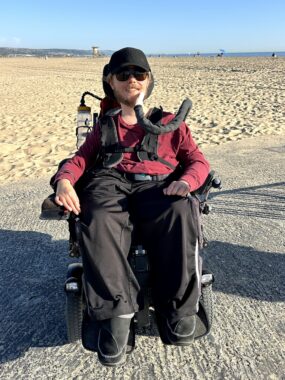
Dusty Brandom enjoys a day at the beach. (Courtesy of Dusty Brandom)
Much of the work involved programming, and artificial intelligence became a great collaborator throughout the process, helping me learn new concepts and work through technical issues I wouldn’t have been able to solve on my own. It didn’t replace my creativity, but it did expand my knowledge.
It felt so amazing to fly my drone again after so many years of it not being possible. But I didn’t stop there. I expanded the same system to work with remote-controlled cars and, finally, with a model airplane, which is something I’ve been wanting to try for a long time. After about 12 years of increasing physical difficulty, I finally have a system I can use independently with ease.
This project is about more than just flying and driving. It has given me a fulfilling project to continue creating, exploring, and building.
My new invention is now pending a patent, but for me, the most rewarding part has been proving that when one approach no longer works, another can be created. Duchenne has changed what I can do physically, but it hasn’t taken away my curiosity or my determination to keep inventing.
To submit your own Guest Voice for publication on Muscular Dystrophy News, please email your idea to our community editorial manager at [email protected] with the following included in the subject line: “Guest Voice: Muscular Dystrophy News.”
Note: Muscular Dystrophy News is strictly a news and information website about the disease. It does not provide medical advice, diagnosis, or treatment. This content is not intended to be a substitute for professional medical advice, diagnosis, or treatment. Always seek the advice of your physician or another qualified health provider with any questions you may have regarding a medical condition. Never disregard professional medical advice or delay in seeking it because of something you have read on this website. The opinions expressed in this column are not those of Muscular Dystrophy News or its parent company, Bionews, and are intended to spark discussion about issues pertaining to muscular dystrophy.

Leave a comment
Fill in the required fields to post. Your email address will not be published.